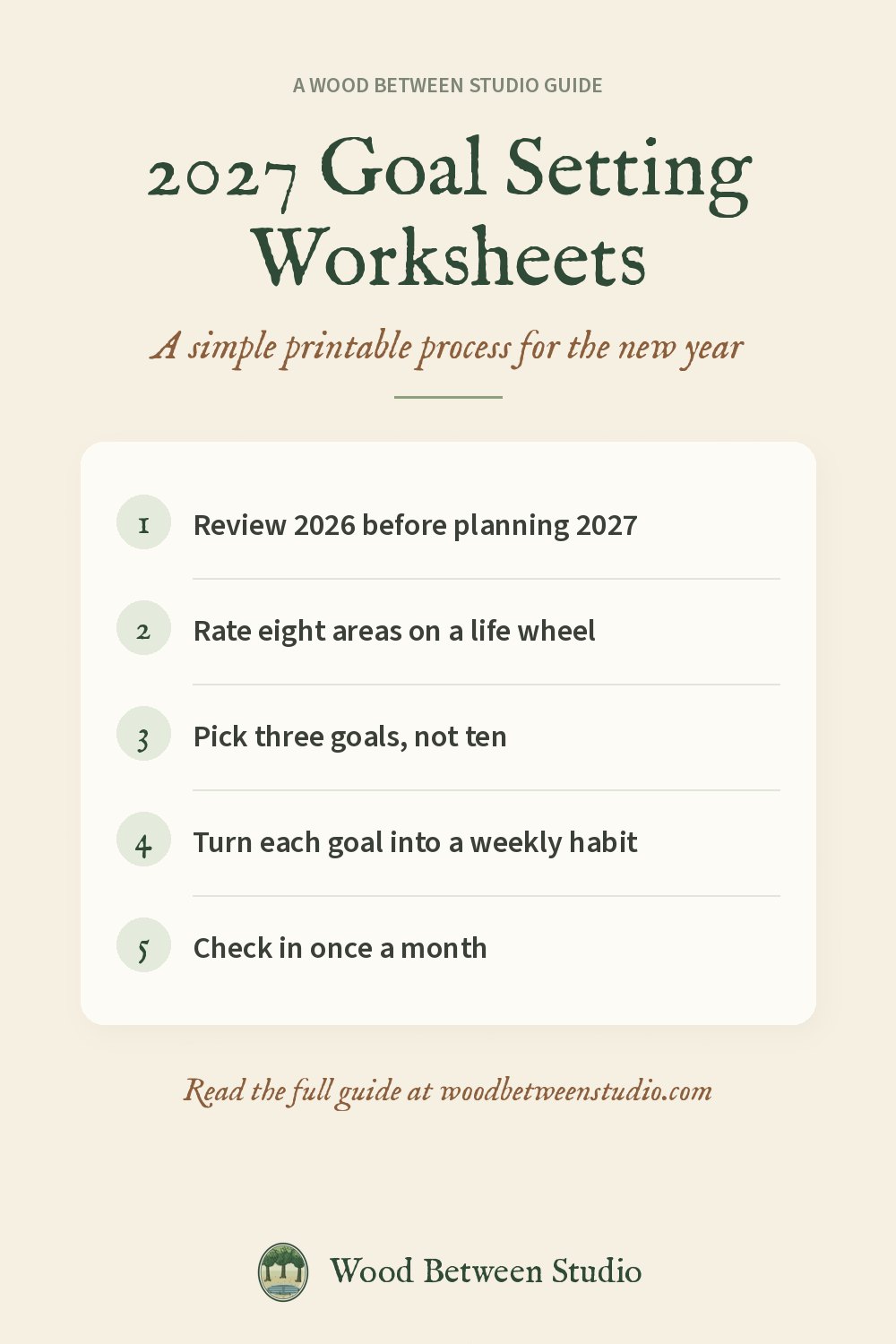
2027 Goal Setting Worksheets: A Simple Printable Process for the New Year
Most new year goals don't fail because people lack willpower. They fail because the goals were vague, there were too many of them, and nobody looked at them again after January 10. A good set of goal setting worksheets fixes all three: it makes you look back before you look ahead, narrows a long wish list to a few goals, and gives you a page to come back to each month.
Here's a simple process for 2027, in the order the worksheets work best. Set aside an evening between Christmas and New Year, or two shorter sessions, with a cup of something warm and a pen.
Step 1: Review 2026 first
Before setting new goals, spend twenty minutes on the year that's ending. Write down:
- Highlights: the best moments, big and small.
- What you're proud of: including things nobody else noticed.
- What was hard, and what it taught you.
- What to let go of: a habit, a commitment, a worry you want to leave in 2026.
This matters because goals set without a review tend to repeat last year's list. The review shows you what actually made the year good, which is usually a better guide than what you think you should want.
Step 2: Rate your life wheel
A life wheel is a circle divided into eight areas, such as health, work, money, relationships, home, learning, fun and rest. Rate each from 1 to 10 for how satisfied you feel right now, and shade each slice to that level.
The shape tells you a lot at a glance. You don't need to make every area a 10. Look for one or two areas that are low and that you care about. That's where a goal will make the biggest difference to how 2027 feels.
Step 3: Choose a word for the year
A word of the year is a single word that sums up how you want 2027 to feel: steady, home, brave, simplify, health, rest. It's a compass for decisions that your goals don't cover. When a new commitment comes along in March, you can ask whether it fits your word.
Write it somewhere you'll see it daily, such as the front of your planner or a card on the fridge.
Step 4: Pick three goals, not ten
Look at your review and your life wheel, and choose no more than three goals for the year. Three is enough to change a year, and few enough to remember without looking.
Write each goal so that you'll know when it's done:
| Vague | Clear |
|---|---|
| Get healthier | Walk 30 minutes, 4 days a week |
| Save money | Save $3,000 in an emergency fund by December |
| Read more | Read 12 books, one a month |
| Be less busy | Keep one evening a week free of plans |
If a goal can't be measured, make it a habit instead: "a phone-free dinner every night" is clearer than "be more present".
Step 5: Break each goal into steps
A goal action plan turns "save $3,000" into something you can do this week. For each goal, write:
- Why it matters to you. One honest sentence. You'll need it in February.
- The first step, small enough to do in the next seven days.
- Quarterly milestones: where you want to be by the end of March, June, September and December.
- Likely obstacles, and what you'll do when they show up.
- A reward for reaching each milestone.
The quarterly milestones are the part most people skip, and they're the most useful. A year is too long to feel urgent; a quarter isn't.
Step 6: Turn goals into habits
Goals are reached through small repeated actions. For each goal, pick one habit you can track: walk after lunch, move $60 to savings each Friday, read 15 minutes before bed. Put those habits on a monthly habit tracker and tick them off each day. Our guide to a simple habit tracking method explains how to keep a tracker going past February.
Step 7: Make a vision board
A vision board is a page of pictures and words that show what you're working toward. It sounds soft, but it works as a daily reminder. Keep it small and specific: a photo of the trail you want to walk, the word of your year, a picture of the room you want to clear, the number in your savings goal. Pin it above your desk or inside a cupboard door you open every day.
A printable vision board kit saves you from hunting through magazines: print a base page, cut out words and frames, and add your own photos.
Step 8: Check in once a month
Put a 20-minute "monthly reset" in your calendar for the first Sunday of each month. Look at your three goals, update your habit tracker, and ask:
- What went well last month?
- What got in the way?
- What's the one thing to focus on this month?
That single habit, looking at your goals monthly, is what separates goals that last from goals that fade. If you use a planner, write the reset into it now for all twelve months. Our guide to planning your year for 2027 covers setting up a planner around these goals.
Our printable 2027 goal setting kit
The 2027 Goal Setting & Vision Board Kit has every worksheet in this guide: a 2026 year in review, a life wheel, a 2027 word and intentions page, a goal planner for eight life areas, a goal action plan with quarterly milestones, a quarterly roadmap, a monthly habit tracker, a monthly reset page, and a vision board base with 60 cut-out words, 6 photo frames and 12 botanical cut-outs. It's 16 pages, US Letter and A4, with fillable fields, for $7.
To keep goals visible all year, pair it with our editable 2027 Botanical Calendar or the dated 2027 Planner.
Quick answers
When should I set goals for 2027? In the last week of December is ideal, when there's time to reflect. Early January works just as well. It's never too late to start.
How many goals should I set for the year? Three at most. More than that splits your attention and makes it hard to track any of them.
What's the difference between a goal and a habit? A goal is a result you want; a habit is the repeated action that gets you there. Track the habit, and check the goal monthly.
Do vision boards work? They work as reminders, not magic. A small, specific board you see every day keeps your goals in mind when daily life crowds them out.