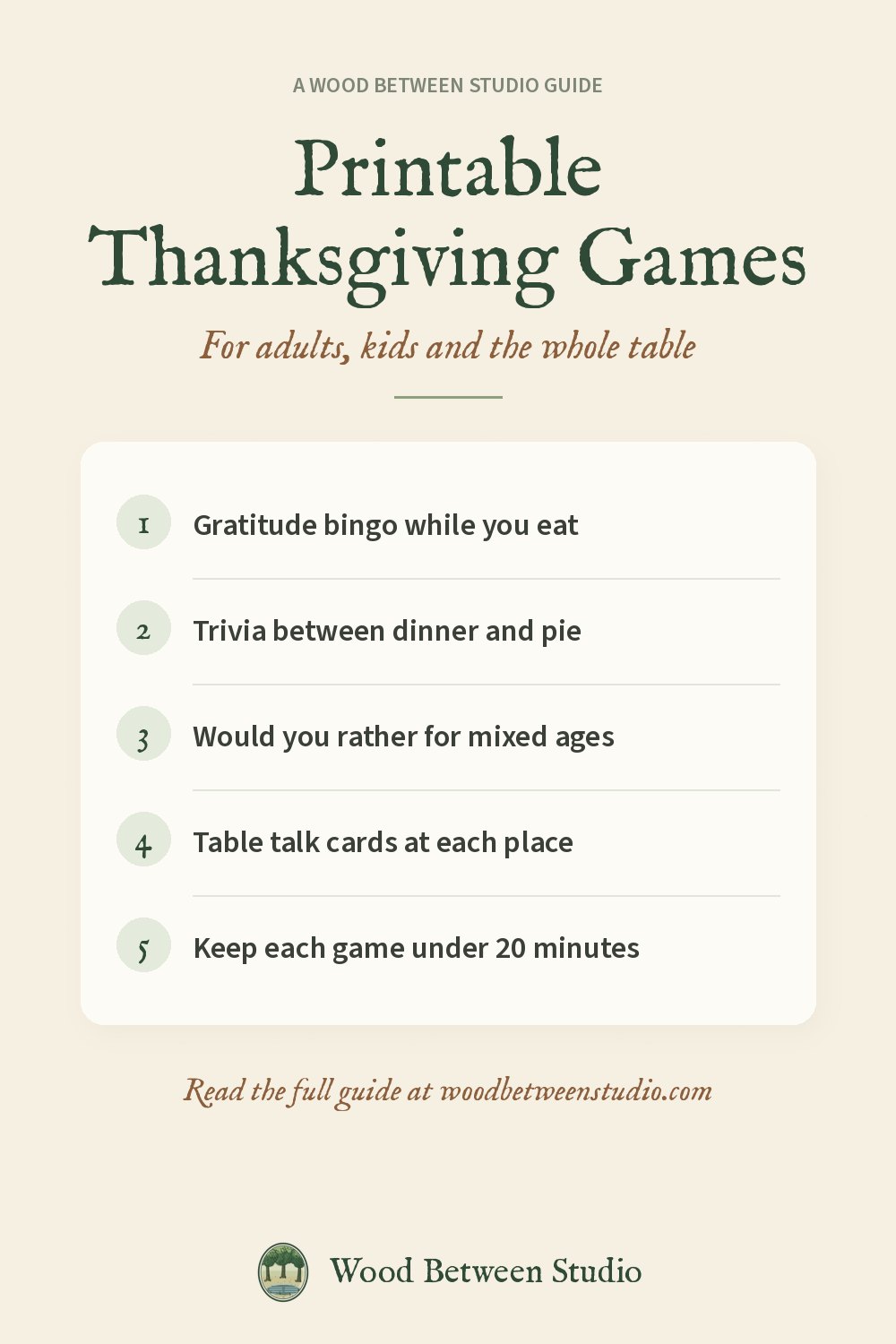
Printable Thanksgiving Games for Adults and Families (That People Actually Play)
Thanksgiving has a natural lull. The food is done, the dishes can wait, and half the table is drifting toward phones or the football game. A few printable games, set out before anyone sits down, turn that lull into the part of the day people remember.
This guide covers the games that work best at a real Thanksgiving table, how to run each one without it feeling like a forced party activity, and how to set everything up the night before. Everything here works with a home printer and a pair of scissors.
What makes a good Thanksgiving game
Most party games are built for a living room full of people who came to play. Thanksgiving is different. You have a seated table, a wide range of ages, a few people who would rather not perform, and food that needs attention. The games that work best share four things:
- They can be played sitting down. Nobody has to stand up, act something out or leave the table.
- They take one sheet of paper or one card per person. No boards, dice or pieces that end up in the gravy.
- They have no wrong answers, or the wrong answers are funny. Nobody should feel tested.
- They end on their own. A round of bingo or ten trivia questions has a natural stopping point, so the game doesn't drag on past dessert.
With that in mind, here are the games worth printing.
1. Gratitude bingo (during the meal)
Gratitude bingo is the gentlest way to bring a little gratitude into the meal without asking anyone to give a speech. Each person gets a bingo card with squares like "something that made you laugh this year", "a person who helped you" or "a meal you'll never forget". When someone shares something that fits a square, everyone who has that square marks it.
How to run it:
- Put a card and a pen at each place before people sit down.
- Explain the one rule when everyone has a plate: "Share one, mark one." When you tell the table something that fits a square on your card, you mark it.
- The first person with a full row calls bingo and wins the first slice of pie, or first pick of leftovers.
Why it works: It turns "say what you're thankful for" from a spotlight moment into a game, so quieter guests can share small things. Kids love marking squares, and adults end up telling better stories than they would on the spot.
Tip: Print one or two more cards than you have guests. Someone always spills on theirs.
2. Thanksgiving trivia (between dinner and dessert)
Trivia fills the gap while the coffee brews and the pies warm. Keep it light: food history, a few famous parades and football facts, and some "which state grows the most..." questions.
How to run it:
- Split the table into two or three teams by where people are sitting, so nobody has to move.
- Let one person read the cards and keep score. A teenager is often happy to do this job.
- Play 10 to 12 questions, not 40. Stop while people are still enjoying it.
- Give a silly prize: the wishbone, the last dinner roll, or the right to skip dish duty.
Tip: Mix easy and hard questions. If a team gets three wrong in a row, give them an easy one next. Nobody likes losing badly at a family dinner.
3. Would you rather (for mixed ages)
Would you rather questions are the best single game for a table with grandparents, teenagers and small children all together. "Would you rather eat only stuffing or only pie for a week?" gets a seven-year-old and a seventy-year-old talking to each other.
How to run it: Put a short stack of cards in the middle of the table. Anyone can draw one and read it out, everyone answers, and the person who drew it picks who explains their answer first. There's no score and no winner.
Tip: Read a few cards yourself before dinner and take out any that don't suit your crowd.
4. Table talk and conversation cards (for adults)
Conversation cards are a quieter game, but they're often the one adults remember most. Questions like "What's a tradition you'd like to start?" or "What did your family always eat on holidays when you were small?" open up stories that don't come out in normal small talk.
How to use them:
- Tuck one card under each plate, or put one on the back of each place card, so everyone has a question waiting.
- During a pause, ask the person on your left to read theirs.
- Let people pass. A conversation card should never feel like an interview.
This is especially good when you're hosting people who don't know each other well, such as in-laws meeting for the first time or a Friendsgiving with friends from different parts of your life.
5. A gratitude tree (for kids, all day)
A gratitude tree is less a game and more an activity that runs in the background. Print a tree poster and a sheet of paper leaves. As guests arrive, everyone writes something they're thankful for on a leaf and tapes it to the tree. By dinner the tree is full, and someone can read a few aloud before the meal.
Kids will happily take charge of this, which keeps them busy while the adults finish cooking.
How to set everything up the night before
Thanksgiving morning is no time to fight with a printer. Do this the evening before:
- Print on card stock. 65 to 110 lb card stock makes place cards and game cards stand up and survive a spilled drink. Plain paper is fine for bingo cards.
- Print at "Actual size" or 100%. Printers often shrink pages to fit, which throws off cut lines and folds.
- Type names before printing. If your printable has fillable fields, type guest names into the place cards in a free PDF reader before you print.
- Cut everything with a paper trimmer if you have one. It's much faster than scissors for 40 cards.
- Sort games into envelopes or small bowls, one per game, so the host can bring each one out at the right moment.
- Put a pen at every place. This is the step everyone forgets.
A simple game plan for the day
You don't need to play everything. Here's an order that suits most tables:
| When | Game | How long |
|---|---|---|
| As guests arrive | Gratitude tree | All afternoon |
| During the meal | Gratitude bingo | 15 to 20 minutes |
| Between dinner and pie | Trivia | 15 minutes |
| With dessert | Would you rather or table talk | As long as it's fun |
If your crowd isn't into games, skip trivia and just leave conversation cards on the table. They'll get picked up.
Thanksgiving games for adults only
For a Friendsgiving or an adults-only dinner, lean on the games where answers become stories: table talk, would you rather and a quick trivia round with a competitive edge. You can raise the stakes with a small prize, such as a nice bottle of olive oil or the leftover pie. Adults tend to enjoy trivia more when teams are mixed so couples are split up.
Our printable Thanksgiving pack
We made the Thanksgiving Table & Games Pack so everything above matches on one table: fillable place cards in two designs, ready-made and blank menus, a gratitude tree poster with leaf cutouts, eight gratitude bingo cards, 24 trivia cards with answers, 24 would you rather cards and 16 table talk cards. It's a 23-page PDF in US Letter and A4, decorated with hand-coloured 19th-century botanical plates of oak, maple, wheat and pears. It's $6 on Payhip or Gumroad.
If you're hosting for the rest of the season too, the Holiday Printables Bundle adds a family Advent activity calendar and 24 Christmas and New Year's Eve party games for $15 in all.
Planning the food budget for the day? Our guide to setting a holiday budget covers hosting costs as well as gifts.
Quick answers
How many games should I plan for Thanksgiving? Two or three is plenty: one during the meal, one after, and conversation cards for whoever wants them.
What's a good Thanksgiving game for a big family? Gratitude bingo, because everyone plays at once from their seat and there's no limit on players.
What games work for kids and adults together? Would you rather and the gratitude tree. Both have no wrong answers, so young kids can play as equals.
When should I print? The day before. Card stock, Actual size, and a pen at every place.